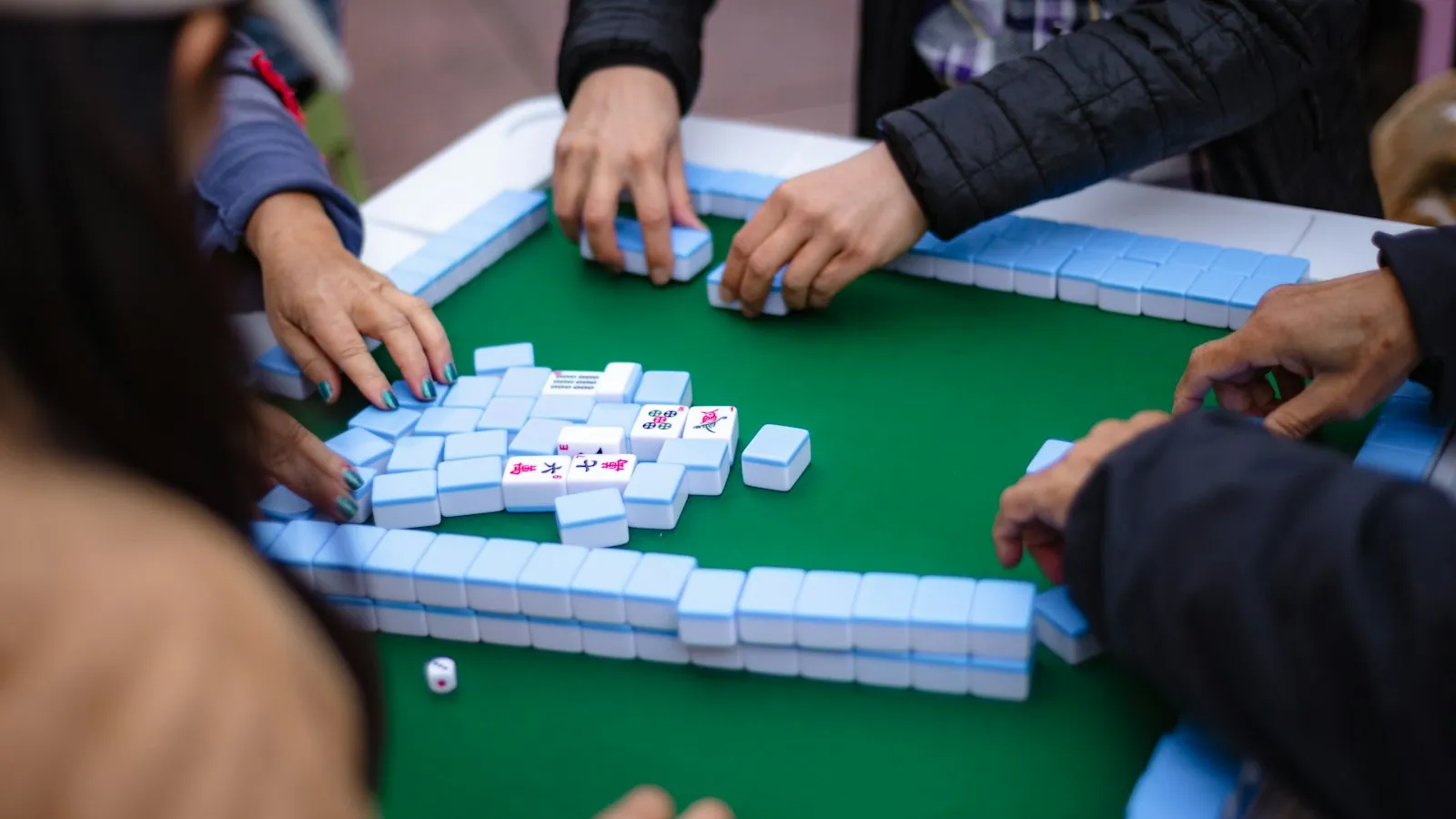
How to play
How to play American mahjong: a beginner's guide

If you want to know how to play American mahjong, the short version is this: it is a tile game with a yearly hand card, and the rules are easier to pick up at a real table than from a rulebook. This guide walks through the whole game in order, with a deeper article for the step that confuses people most, the Charleston.
From the team: We love mahjong and teaching it, and we wrote this guide for people sitting down to their first game. We kept the steps short and gave the part that trips up most beginners, the Charleston, its own article.
Rules vary: Home tables often play with slightly different house rules. For official American rulings, see the National Mah Jongg League’s Mah Jongg Made Easy booklet, and ask your group which rules it uses.
On this page: How to play in one minute · What you need · The tiles · Step by step · Two or three players · First-game tips · What to do next
How to play American mahjong in one minute
Four players each build a 14-tile hand that matches one of the hands printed on that year’s card. First, everyone trades tiles in the Charleston. Then, in turn, you draw a tile and discard a tile, and you may claim another player’s discard when it completes a group of three or more identical tiles. The first player to complete a hand on the card says “Mahjong” and the others pay.
That is the core idea. Everything else is how you get there.
What you need
- Four players. Four is the standard game. See two or three players below.
- A set of American mahjong tiles. An American set has 152 tiles. Our guide to American mahjong tiles shows what each one is.
- Racks. Each player gets a rack to hold tiles upright and private. Many racks include a pusher, an arm that slides the wall (the rows of face-down tiles you draw from) toward the middle.
- The current card. Players buy the card each year from the National Mah Jongg League. It lists the hands you can win with.
- A table and dice. Dice decide who is East (the dealer) and where the wall is opened.
About the card: The annual card is published by the National Mah Jongg League. We describe how it works but never reproduce it. You can buy the official card from the League at nationalmahjonggleague.org.
The tiles in one minute
An American set has:
- three suits (Bams, Craks and Dots) numbered 1 to 9, four of each tile: 108 tiles
- four winds, four of each: 16 tiles
- three types of dragons (red, green and white), four of each: 12 tiles
- 8 flowers
- 8 jokers
That adds up to 152. The white dragon is blank on most sets and is called “soap.” On some hands it also stands in as a zero, which the card explains each year.
How to play American mahjong, step by step
Set up
Players shuffle the tiles face-down and build four walls, one in front of each rack. Dice decide who is East (the dealer). The deal is a little unusual: East starts with 14 tiles and everyone else with 13. East is the seat that rotates: after each game it passes to the right.
The Charleston
Before anyone takes a normal turn, players trade tiles in a set pattern called the Charleston. The first Charleston is required: you pass three tiles to the right, three across and three to the left. A second Charleston, in the opposite order (left, across, right), happens only if nobody stops it, and the Charleston ends with an optional courtesy pass across the table. Two- and three-player games skip it.
It feels like a lot the first time. The full order, the blind pass and the courtesy pass are in the Charleston guide linked near the top of this page.
Choose a hand to aim for
After the Charleston, look at your tiles and at the card. Pick a hand that fits what you already hold. You are allowed to change your mind as the game goes on, as long as any sets you have already exposed still fit the new hand. Beginners often lock in too early, so stay flexible.
Take turns
East starts by discarding one tile and saying its name out loud. Play then moves to the right. On your turn:
- Draw a tile from the wall (or claim the last discard, see below).
- Decide whether the tile helps your hand.
- Discard one tile face-up in the middle and call out its name.
After your discard you should be holding 13 tiles. East is the one exception at the very start, because East holds 14 and discards first without drawing.
Claiming a discard (calling)
When someone discards a tile, you may be able to take it instead of waiting for your normal draw. In American mahjong you can claim a discard only to complete a group of three or more identical tiles (a pung, kong, quint or sextet), or as the last tile that completes your winning hand. You then place that group face-up on your rack. This is called exposing, and it tells the table what you are building.
A few rules that trip up new players:
- You can only claim the most recent discard, and you have to do it before the next player in turn has drawn and racked a tile (or discarded).
- There are no chows. You cannot claim a discard to make a run like 4-5-6. The one exception is a discard that completes your winning hand.
- Hands the card marks as concealed cannot claim discards at all, except to win.
- A quint (five identical tiles) needs a joker, because only four of any tile exist. Flowers are the exception, since there are eight.
Jokers
Jokers can stand in for tiles in groups of three or more. They cannot be used in a pair or as a single tile, and they can never be passed in the Charleston. A discarded joker is dead: nobody can claim it.
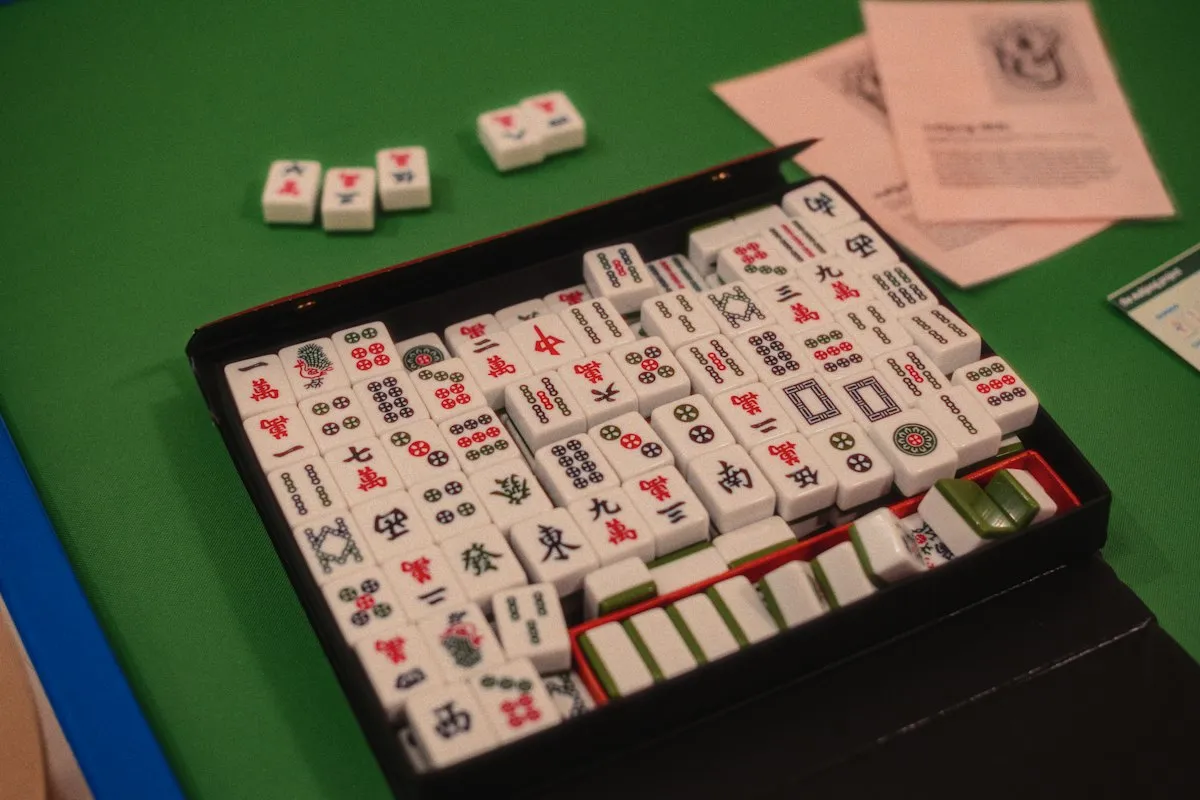 Photo by Jason Leung on Unsplash
Winning
When your tiles complete a hand on the card, whether by drawing the tile you needed or by claiming a discard, say “Mahjong.” Show your hand so the table can confirm it matches the card.
Payment follows the value printed on the card. The usual League schedule is simple: if someone wins on your discard, you pay double and the other two pay the printed value; if the winner draws the tile themselves, all three players pay double. Some tables change the details, so agree on them before you start. (We do not reproduce the card’s hand values.)
If the wall runs out and nobody has won, the round is a draw (a “wall game”) and nobody pays.
Can you play with two or three players?
Yes. Two-player and three-player versions exist, but they skip the Charleston and are played a little differently, so ask your group which version they mean before you sit down.
Five tips for your first game
- Play with friendly people. A patient table is the best teacher.
- Keep your card handy and flip through it. Nobody memorizes it in a night.
- Stay flexible. Keep your options open for the first few turns.
- Count your tiles. Count before the Charleston and again after it. A wrong count can mean a redeal or a dead hand.
- Ask before you discard something unusual. Most groups are happy to coach a new player.
What to do next
- Read American vs Chinese vs Riichi mahjong if you are not sure American is the version you want.
- Practice the Charleston with a friend.
- Buy the official card from the National Mah Jongg League when the new one comes out.
Sources
Rules summaries below follow the League’s published guidance as quoted by these sources. The League’s Mah Jongg Made Easy booklet is the authority, and this article has not yet been checked against the current edition.
- National Mah Jongg League (official site, card and Mah Jongg Made Easy booklet). https://www.nationalmahjonggleague.org/
- The Order of the Tile, American mahjong rules by ID (an independent rules reference built on the League’s rulebook; see T-1, S-4, C-1, C-3, C-5, P-1, V-1, SC-2, SC-3, W-1). https://orderofthetile.com/rules/
- The Charleston. The Complete American Mah Jongg Rulebook, American Mah Jongg Association (third party, not the League). https://guide.americanmahjonggassociation.com/how-to-play-american-mah-jongg/the-charleston/
- American mahjong. Wikipedia overview. https://en.wikipedia.org/wiki/American_mahjong
- NMJL card life cycle. Mahj Life wiki (supports the “new card each year” point only). https://mahjlife.com/wiki/life-cycle-of-the-national-mah-jongg-league-card-article-3/